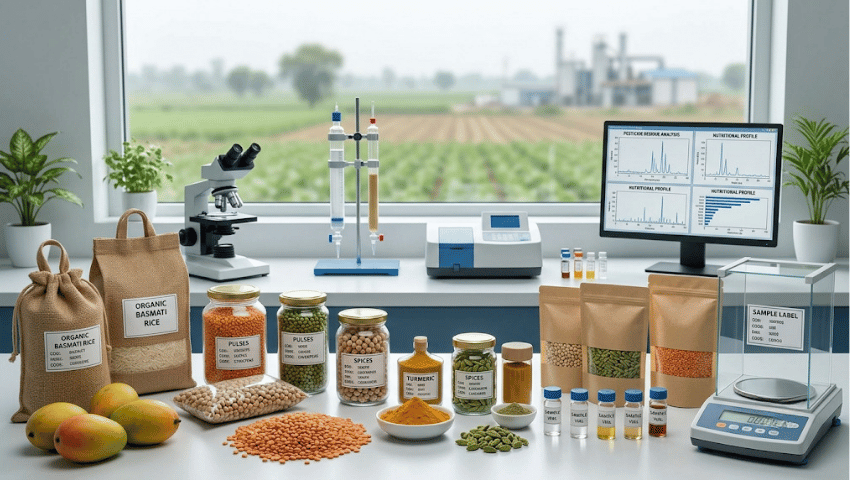
An Overview by Team ISSPL - Analytical Testing Laboratory in India
ToggleOrganic food is no longer something which we only find at speciality stores. Today, you can easily find organic rice, spices, tea, honey, cereals, oils and several other products on supermarket shelves and online marketplaces. However, when a brand claims that a food product is organic, customers naturally expect much more than just attractive packaging with the word “organic” written on it.
This is where testing becomes important. For example, what happens if an organic spice contains pesticide residues? Or what if a batch of organic grains has excessive heavy metals or microbial contamination? Even when the raw material has been sourced from an organic farm, the finished product still needs to meet applicable food safety and quality requirements.
Hence, Organic Food Product Testing in India is an important step for brands, manufacturers and exporters before taking their products to the market. It can help identify unwanted residues, contaminants and quality issues before they eventually turn into a bigger problem.
Why Does an Organic Product Need Laboratory Testing?
If food is organic, you must be wondering why it needs so much testing in the first place. Well, organic certification and laboratory testing serve related but different purposes.
Organic certification primarily verifies whether the product has been produced and handled according to applicable organic production standards. In India, organic foods may be certified under systems such as the National Programme for Organic Production (NPOP) or Participatory Guarantee System for India (PGS-India). FSSAI’s organic food framework is linked with these systems.
Laboratory testing, on the other hand, examines the actual product sample for specific parameters. Therefore, it can help determine whether pesticide residues, heavy metals, microorganisms or other unwanted substances are present.
For a food business preparing for certification, product launch, export or marketplace approval, both aspects can become important.
Pesticide Residues Should Be One of the First Checks
Organic farming places restrictions on the use of conventional synthetic pesticides. However, residues can still enter a product because of contaminated soil, neighbouring farms, storage conditions, transportation or accidental mixing.
Hence, pesticide residue analysis is one of the important areas to consider during Organic Food Product Testing in India.
This becomes particularly significant for exporters. Under NPOP procedures, testing parameters for organic operations can include pesticide residues along with other contaminants, while requirements may also vary according to the destination country or region.
Testing beforehand can give manufacturers and exporters a better understanding of the batch before it reaches certification, customer or export-related scrutiny.
Do Not Ignore Heavy Metals
Another problem which may not be visible to the naked eye is heavy-metal contamination.
Food and agricultural commodities can potentially be exposed to metals through soil, water, environmental conditions or processing. Naturally, simply looking at rice, pulses, herbs or spices will not tell you whether such contamination exists.
Therefore, heavy-metal testing can form an important part of a product testing plan. ISSPL includes heavy-metal analysis among its Food & Agriculture laboratory testing capabilities.
This can be particularly relevant for food brands dealing with agricultural commodities, herbs, spices and processed products.
Microbiological Testing Is Equally Important
Organic does not automatically mean microbiologically safe.
Food can become contaminated during harvesting, processing, storage, packing or transportation. Poor hygiene or unsuitable storage conditions can further increase the possibility of microbial contamination.
This is why microbiological testing deserves attention before market release. Depending upon the product and applicable requirements, a testing programme can help assess microbiological quality and identify potential food safety concerns.
For a brand, detecting such an issue in the laboratory is certainly better than discovering it after products have already reached distributors or consumers.
Aflatoxins Can Become a Serious Quality Concern
If your business deals with grains, nuts, spices, oilseeds or similar agricultural commodities, aflatoxin analysis may also be relevant.
Aflatoxins are toxins associated with certain moulds and can become a concern when agricultural commodities are exposed to unsuitable growing or storage conditions.
ISSPL lists aflatoxin analysis among its Food & Agriculture testing services.
Hence, this is one more parameter that manufacturers and exporters should consider based on the nature of their product and applicable specifications.
What Else Should Brands Consider Testing?
There cannot be one identical test package for every organic food. A packet of organic tea and a processed multi-ingredient food, for example, may have completely different testing requirements.
Depending upon the product, intended market and applicable specification, testing requirements may include:
- Pesticide residues
- Heavy metals
- Microbiological parameters
- Aflatoxins
- Physicochemical parameters
- Nutritional parameters
- Residual solvents
- Stability-related parameters
The right approach is therefore to determine the testing scope according to the actual food product rather than choosing tests simply because another brand uses them.
ISSPL’s Food & Agriculture testing portfolio includes physicochemical parameters, nutritional labelling, residual solvents, aflatoxins, heavy metals, pesticide residues, microbiological testing, stability studies and method validation, among other capabilities.
Testing Becomes Even More Important for Exporters
Selling an organic food within India is one matter. Exporting it can add another layer of requirements.
Different importing markets can have their own limits, testing expectations and residue requirements. APEDA’s export resources, for example, publish product and destination-specific procedures and information concerning maximum residue limits and agrochemicals for certain exports.
Therefore, exporters should not assume that compliance for one market automatically makes the same shipment suitable for every other country.
This is where proper Organic Food Product Testing in India before dispatch can become valuable. Testing against relevant requirements may help exporters identify issues before the shipment reaches the importing market.
Why Test Before the Product Is Released?
Consider the alternative. A company manufactures a large batch, completes the packaging, sends products to warehouses and then discovers a contamination problem.
By that stage, the problem is no longer limited to one laboratory sample. It may involve stock segregation, investigation, delayed dispatch, customer concerns and possible commercial losses.
Testing earlier provides an opportunity to identify problems when corrective action may still be possible.
Therefore, laboratory testing should ideally be treated as part of the quality-control process and not merely as something a business does after a problem arises.
Choose ISSPL for Food & Agriculture Testing
If you are looking for reliable Organic Food Product Testing in India, ISSPL Limited offers comprehensive Food & Agriculture laboratory testing services for manufacturers, brands, exporters and other food businesses.
ISSPL’s testing capabilities cover food products including cereals and pulses, fruits and vegetables, herbs and spices, edible oils, tea, coffee, milk products, nuts, oilseeds, processed foods, honey and many other food categories.
Its laboratory holds approvals and recognitions from organisations including NABL, FSSAI, APEDA and EIC. ISSPL also states that it has a pan-India network of more than 40 sample collection centres, helping businesses access its testing capabilities across the country.
Test Before You Take Your Organic Product to Market
Building an organic food brand requires trust. However, that trust cannot depend only on the word “organic” printed on the package. The quality and safety of the actual product matter just as much.
Whether you are preparing for certification, launching a new product, supplying a marketplace or planning an export shipment, appropriate laboratory testing can help you understand the product before it reaches the next stage.
Contact ISSPL Limited today to discuss your organic food product, applicable testing requirements and the right laboratory testing scope for your business before market release or export.